
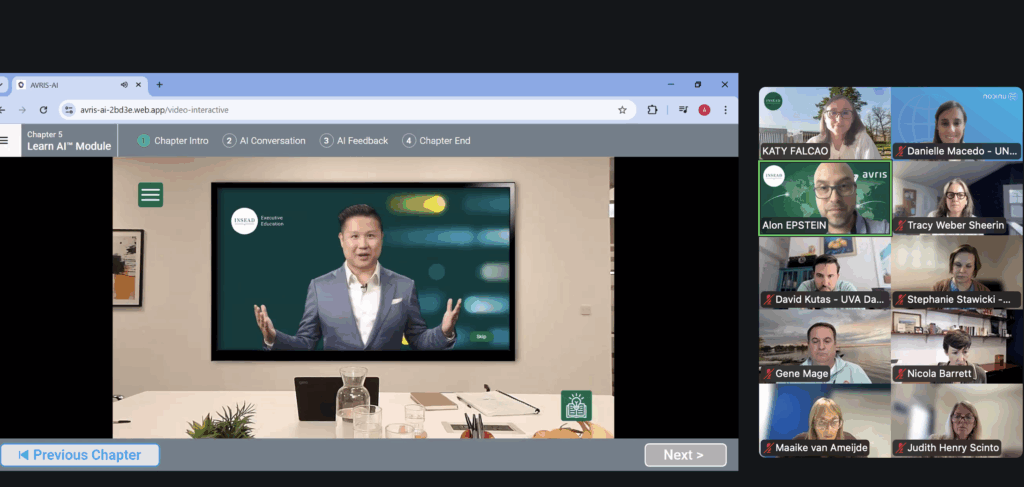
This month, the UNICON’s Tech Disruptors Group came together for two informal “Emerging EdTech Coffee Talks” (February 4 & 5, 2026). The conversations were exactly what this group does best: candid, practical, and refreshingly honest about what’s working, what’s messy, and what we’re all still figuring out when it comes to EdTech and AI in executive education.
Colleagues joined from a range of institutions, including
Aalto University,
INSEAD,
ESCP Business School,
Nova School of Business & Economics,
Nanyang Technological University,
Stanford University,
Yale University,
University of British Columbia,
Emory University,
University of Virginia,
University of South Carolina,
University of Utah,
and London Business School.
Key themes from the latest discussions
1) The “where does AI live?” question
A recurring thread was that AI work often sits between functions (IT, digital learning, marketing, programme teams), which creates ambiguity around ownership, budgets, and delivery speed.
Several members described the tension between business teams wanting to move quickly and IT needing to manage security, governance, and core infrastructure priorities.
The group compared approaches: some institutions are enabling experimentation within clear guardrails (especially around data), while others are still navigating internal maturity and collaboration models.
2) Chatbots
One institution shared that they launched a chatbot for EMBA and Executive Masters recruitment to handle common early-stage questions and reduce time/resource pressure.
A quick observation from the chatbot experiments
- Some candidates feel more comfortable asking “basic” questions to a bot than to a person.
- Usage spikes outside office hours (including at night), suggesting value as an always-on entry point.
This led to a broader question: should AI play a role in the application/recruitment phase in ExecEd, and if so, how far? The group discussed the ethical and quality concerns—particularly for high-stakes, high-standard executive programmes—alongside the practical reality that AI may help with early screening or guidance, with humans still involved for judgement and relationship-building.
3) “AI in the workflow” is where the momentum is
Tools like Copilot and automation platforms are helping teams reduce admin load and free up time for the work that actually needs humans.
4) Avatars and synthetic media (HeyGen) — benefits and boundaries
The group compared notes on faculty avatars and synthetic video:
- One institution shared an example built with HeyGen, noting that lip-sync/voice alignment still takes meaningful production effort and may not yet be “prime time” for ExecEd.
- Another shared a use case using HeyGen to translate lecture videos into other languages to expand reach across geographies.
- One institution shared an internal observation: some audiences react better when avatars are less hyper-realistic, reducing the “creepy” factor.
- A practical best practice emerged: framing matters—explaining why an avatar is used (e.g., rapid content refresh in fast-changing topics) can increase acceptance.
5) Course facilitation, feedback, and the “human touch”
A central question for online and asynchronous learning is: how do we scale without losing high-touch facilitation?
One example discussed was an LMS feature that generates AI feedback on assignments—reviewing a learner’s submission and suggesting what was done well, plus what could be improved. The promise is clear (cost and scalability), but so is the risk: learners may still strongly value human feedback.
Related approaches shared included:
- Using AI tools to help learners master “basic” concepts before class, leading to richer office hours and in-class discussion.
- Using usage data to spot where course content may need strengthening.
What’s next
These coffee talks are a reminder that the most useful insights often come from comparing notes—especially across different operating models, markets, and levels of digital maturity.
If you have a case study to share (successful or not), or a topic you’d love the group to unpack next, email Taryn Streed (UNICON Operations Director) at
tarynstreed@uniconexed.org
to be added to the mailing list, and share your ideas with the group.