
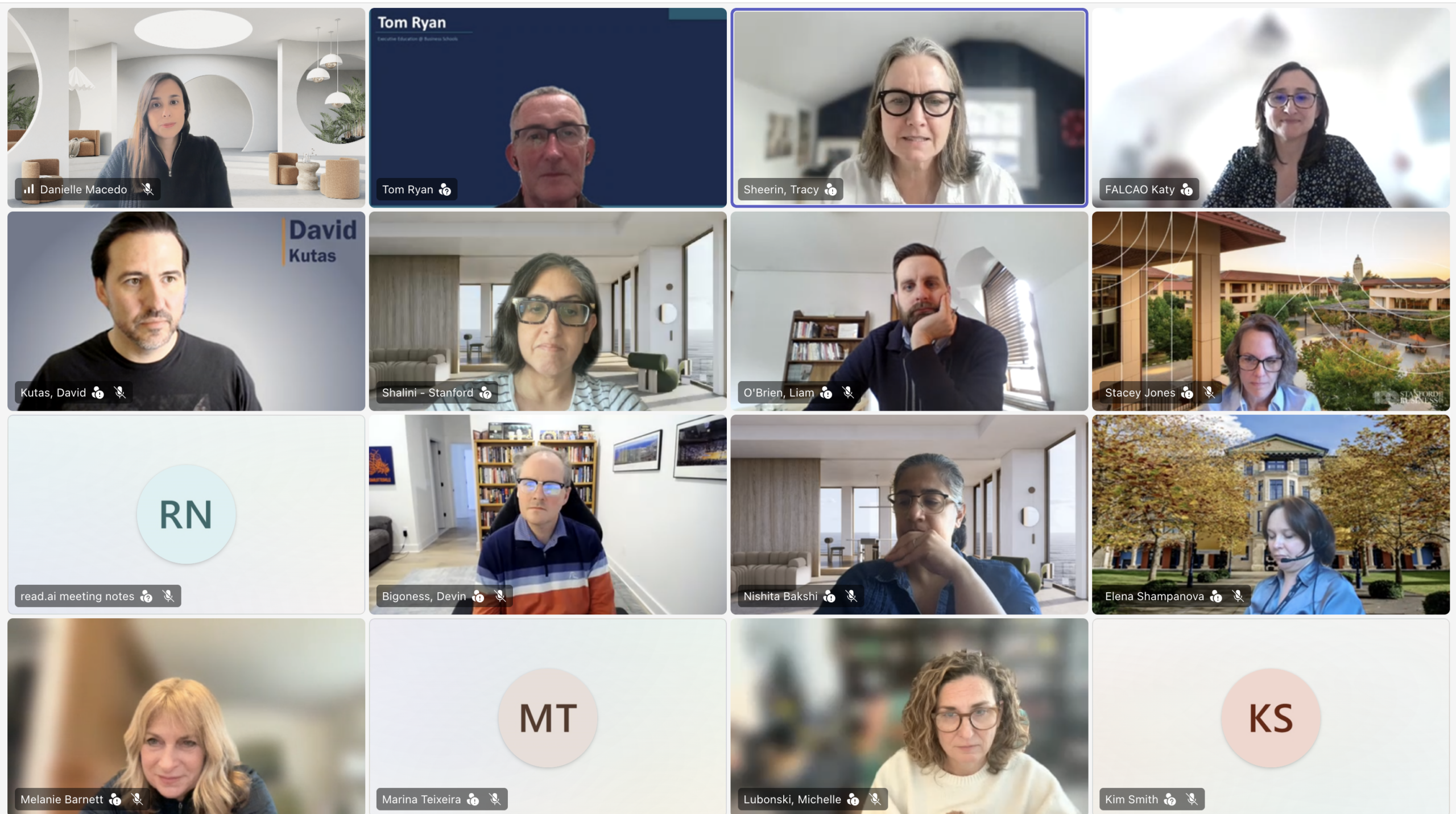
This month, the UNICON Tech Disruptors Group explored how AI can support B2B account management in executive education— from targeting and proposals to client relationships and business development.
Drawing on his own experiments with the leading AI tools and conversations with business schools across the sector, Tom presented a grounded, honest take on where AI adds genuine value, where it falls short, and how schools can start making meaningful progress without waiting for the perfect strategy.
The session was attended by executive education professionals from UNICON member institutions across Europe, North America, and Asia — and the discussion confirmed a shared reality: most schools are still in the experimental phase, and that is entirely normal.
About the speaker

Tom has written several research papers for UNICON examining the implications of new providers, intermediary partnerships, and how schools can build the business case for executive education. He brings both an outsider’s perspective and deep sector knowledge to the AI question — having run the custom programs business at London Business School and worked as a consultant with a range of schools and organizations over many years.
How AI supports B2B executive education teams
Tom mapped out the B2B value chain and identified where AI tools can genuinely support executive education teams. The opportunities fall into two areas:
The key message was pragmatic: schools do not need to go from zero to fully automated overnight. AI adoption can happen in steps — starting with tools that assist human decision-making and gradually increasing autonomy as trust and capability build.
Three dimensions of AI adoption
Tom introduced a framework for thinking about how schools can expand their AI use progressively — rather than trying to transform everything at once.
01
ResponsibilityFrom assisting humans to autonomous decision-making
02
ReachFrom individual use to team-wide adoption
03
AgencyFrom prompted tasks to fully agentic, self-directed workflows
Moving along all three dimensions at once is risky. The more sustainable approach is to advance incrementally — running controlled experiments, learning from them, and locking in improvements before moving further. Tom recommended treating each use case as a cycle of experiment, pilot, implement, and operate.
AI in practice — honest findings from the field
Tom shared observations from his own hands-on experimentation with AI tools applied to real B2B tasks — company research, due diligence, and building target client lists. A number of honest conclusions emerged from the group discussion.
AI in B2B executive education — key takeaways
Start specific
Target repetitive, time-consuming tasks that don’t require complex judgment — like RFP boilerplate or company background research.
Clean your data first
AI integration depends on reliable internal data. Messy CRM systems may need to be addressed before AI can deliver real value.
Build the business case
The most persuasive internal argument is a concrete, measurable win. Prove the value of one use case, then expand.
Nobody is ahead
Even large organizations with significant AI investment are still figuring this out. Schools are not behind — the whole field is in early stages.
Try a hackathon
Get a small group together for a day to focus on one specific problem. Cross-disciplinary teams — including legal and faculty — generate better, safer results than solo experimentation.
About the Tech Disruptors Group
The Tech Disruptors Group is an active UNICON affinity group open to all member school staff. It brings together executive education professionals to share experience, explore emerging technologies, and discuss practical applications for the sector. Sessions run regularly throughout the year — to join the group, simply email tarynstreed@uniconexed.org.
Up next: MIT Sloan, July 16-17, in-person
UNICON Annual Workshop 2026
What Does It Mean to Be Human? People & AI
July 16–17, 2026 · MIT Sloan Executive Education, Cambridge, MA
UNICON’s 2026 Annual Workshop brings the global community together at MIT Sloan’s new Executive Education facilities to explore the evolving role of humanity in a world shaped by AI. Open to executive education professionals across leadership, program development, sales and marketing, and operations.
Register now →