
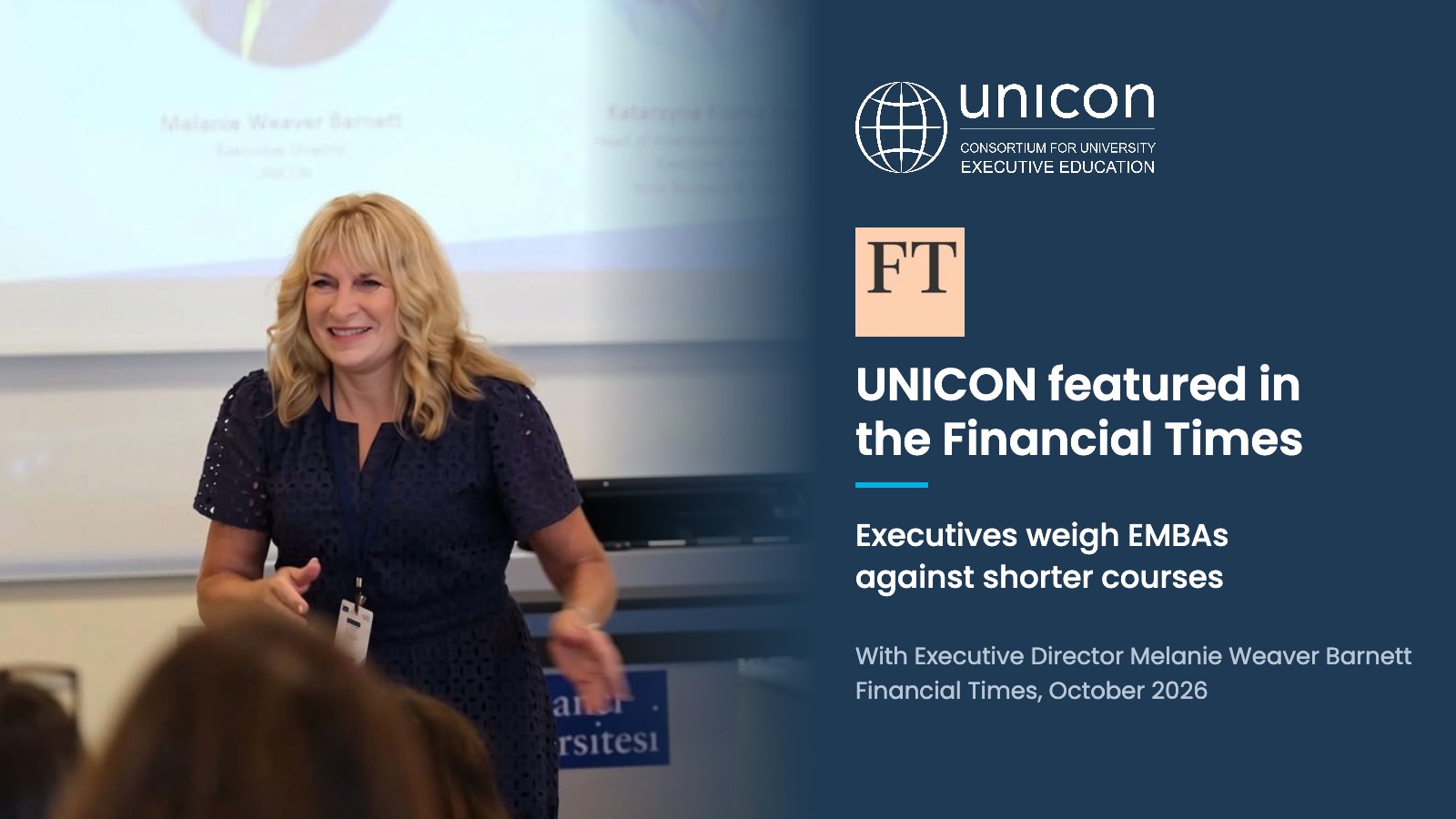

UNICON Executive Director Melanie Weaver Barnett is quoted in the Financial Times in Seb Murray’s High flyers weigh executive MBAs vs shorter courses, published on 6 October alongside the FT Executive MBA Ranking 2026.
The piece asks a question many UNICON members are hearing from clients: why are senior executives increasingly weighing the executive MBA against shorter, focused executive education programmes?
 Melanie Weaver BarnettExecutive Director, UNICON
I do think there are some conditions that make it likely this is happening and will continue to happen if those conditions remain.
Applications to executive MBAs fell in 2025
fall in EMBA applications in 2025, according to the Graduate Management Admission Council (GMAC). Part-time MBA applications weakened too, leaving the traditional two-year full-time MBA as the only format to grow.
What EMBA programmes expect for their next intake
Melanie’s reading is that the pressures behind the shift all line up. When executives are paying for themselves, she argues, a programme of around $10,000 is a far easier decision than a six-figure degree.
Waning employer sponsorship
Fewer companies are funding full degrees, so more executives pay their own way and weigh the cost carefully.
Demand for flexibility
Senior people want learning that fits around the job, with less time away from the office.
Skills over qualifications
The focus is moving to knowledge and tools that can be applied straight away, rather than another credential on the CV.
Shorter programmes win on cost and focus
With employer funding drying up and tuition rising, a focused executive programme is the easier choice for many experienced leaders who know which skills they need.
Executive education wraps around the EMBA
INSEAD’s Virginie Fougea sees people using different formats at different points in their careers, and the FT follows an ESMT Berlin participant whose short programme led him on to the school’s EMBA.
GMAC and the Executive MBA Council both caution against reading too much into one year’s numbers, while schools respond with more online delivery, more scholarships and more flexible campus time. For UNICON members, the piece is a useful read on how senior buyers now think about cost, time and relevance, and on where non-degree programmes sit in that decision.