
AI, Geopolitics, and the Future of Executive Education: #UNICONDirectors 2026 at IMD
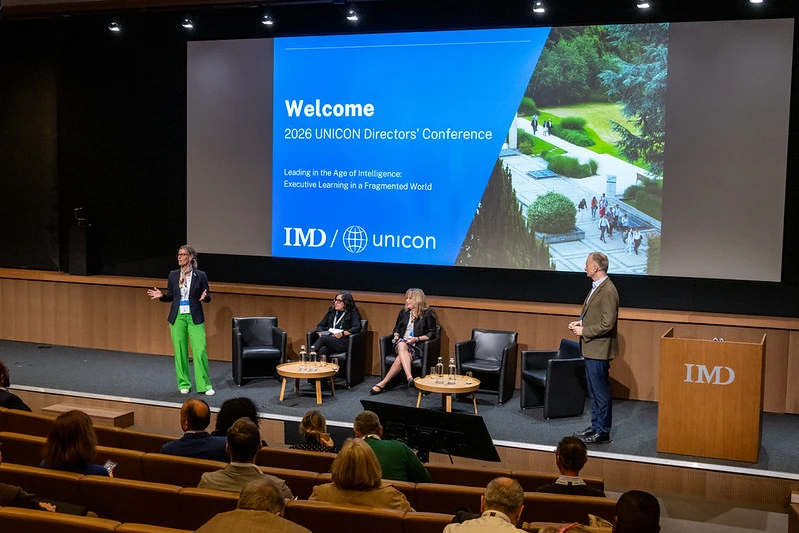
Set against the backdrop of Lake Geneva, UNICON’s 2026 Directors’ Conference brought executive education leaders together at a defining moment – with AI reshaping what is taught, geopolitical fragmentation reshaping who is being served, and rising pressure on the teams delivering it all.
The conference opened with two voices that together captured what UNICON is for. Executive Director Melanie Weaver Barnett framed the moment as one of “polycrisis” – and made the case for why that makes community more important than ever. Board Chair Shalini Bhatia reinforced it with a reminder of what this particular community offers.
“Uncertainty leads us to seek out learning – and that’s what we try to provide our member schools with here at UNICON. Volatility leads us to seek out our tribes – and this is our tribe.”
Melanie Weaver Barnett, UNICON Executive Director
Melanie Weaver Barnett, UNICON Executive Director
“There is only one UNICON – and it’s an amazing community. Take the time to get to know one another.”
Shalini Bhatia, UNICON Board Chair
Shalini Bhatia, UNICON Board Chair
IMD’s focus on executive education
With around 85% of its activity dedicated to executive learning and a long-standing presence near the top of global rankings for both open and custom programs, IMD proved a fitting and inspiring host for this year’s conference.
Continue the Conversation at MIT Sloan
Join the UNICON community at the Annual Workshop at MIT Sloan School of Management, July 16–17, 2026.
Register Now
AI Meets Executive Education
The conference opened with the force reshaping executive education more than any other: artificial intelligence. IMD Dean of Executive Education Misiek Piskorski opened with a simple show of hands — everyone in the room was using AI in their daily work. No one considered themselves an expert.
“The last 3.5 years have been a revolution. After about 80 years of research, in November 2022 ChatGPT made it out of the lab and into the hands of consumers.”
Misiek Piskorski, Dean of Executive Education, IMD
Misiek Piskorski, Dean of Executive Education, IMD
Three frontier developments with particular relevance to executive education were covered: personalization at scale using company-specific unstructured data; agentic AI that can work through tasks and workflows independently; and coding agents that can build full applications from a single prompt.
Three predictions followed: disrupted universities will demand more from their ExedEd functions; AI-powered personalization will make differentiation harder as offerings become “similarly customized”; and the cost of building a world-class internal corporate university will fall massively.
What the Learning Function Needs Today
Four senior learning leaders from ABB, Nestlé, ICRC, and Philip Morris International spoke directly about how the corporate learning function is evolving — and what that means for executive education providers. Moderated by Anna Dunand, IMD’s Chief Business Development Officer, the conversation zeroed in on a pointed and practical question: what do organizations now need from their learning partners?
“Everything that is ‘fact-based’ is no longer interesting to us. AI has taken that piece. What is interesting is how do we activate those facts?”
Mikala Larsen, Head of Corporate Learning, Nestlé
Session 2 — What the Learning Function Needs Today
Three themes emerged with force: the shift from knowledge transfer to activation; the demand for speed — programs need to be designed and deployed in days, not months; and the critical importance of measurement.
“The fundamental disruption of everything in work hasn’t happened yet, but it will. We are looking for partners that can stay with us and ahead of us.”
Filipe Dahlin, VP Global Talent, Philip Morris InternationalOn where executive education fits best, the message was unambiguous: “It’s the leadership side, the mindset shifts needed for leading transformations — not the technical skills.”
The Geopolitical Chessboard and the New Economic Order
Professors Karl Schmedders and Richard Baldwin stepped back from AI to examine a second, equally powerful force: geopolitics. Baldwin described the progression from Cold War “checkers,” through a US-dominated “bingo” era, to today’s “3D chess”, where no single nation leads across all domains and uncertainty is here to stay.

Session 3 — The Geopolitical Chessboard

Session 3 — The Geopolitical Chessboard
“Are you embedding geopolitics into the strategy components of your executive education programs yet? Perhaps you should…”
Karl Schmedders, Professor of Finance, IMDOnly just over half of participants currently offer programs on geopolitics — though 15 years ago, the same was true of sustainability. Geopolitics may be following the same trajectory: from niche topic to core leadership capability. Three future scenarios were outlined: managed fragmentation, hard fragmentation, and chaotic volatility.
Speed Consulting and Future-Back Thinking
Day One closed with a peer “speed consulting” exchange — surfacing shared pressures around client acquisition costs, efficiency demands leaving little room for innovation, and growing market fragmentation between in-person and online.
Day Two opened with Knut Haanaes introducing “future-back” thinking — starting from a hypothetical 2035 and working backwards. Groups explored two scenarios: executive education at its best year ever, and executive education no longer existing.

“Re-framing doesn’t give us all the answers, but it helps us prepare for the future and surfaces opportunities that may be hidden.”
Knut Haanaes, Professor of Strategy, IMDWhere Are the Blue Oceans?
Mark Greeven, Dean of Asia at IMD, mapped global demand. The corporate e-learning market is projected to grow from $27 billion in 2024 to $100 billion by 2030 — with strong opportunities across multiple regions, even as competition intensifies in all of them.
Are You Future Ready? The Ambidextrous Leader
Misiek Piskorski introduced IMD’s Strategic Talent Solutions framework and the concept of the “ambidextrous leader” — one who can perform today while transforming for tomorrow. Based on research across 20,000 leaders annually, only around 12% master all five key leadership paradoxes.
of leaders master all five leadership paradoxes
Leadership is full of profound trade-offs – and based on research across 20,000 leaders annually, only around 12% are able to navigate all of them effectively.
Misiek Piskorski, Dean of Executive Education, IMD
Session 8
Building Strategic Partnerships at Scale
Led by Anna Dunand, this session explored both school-to-school and non-school partnerships – unpacking what makes them work, and the blind spots that can derail them. The key message: start with strategic clarity, not commercial models.
“Trust and transparency are key. As the landscape becomes more competitive, the ability to collaborate across institutions and sectors may become a key differentiator.”
Anna Dunand, Chief Business Development Officer, IMD

Anna Dunand, Chief Business Development Officer, IMD
Session 9
Your Own Personal Resilience
Susan Goldsworthy explored what it takes to sustain high performance in a world of constant uncertainty.
“How do you get to the recovery zone every day? Thriving is not automatic — it requires deliberate effort.”
Susan Goldsworthy, IMD
executives researched on energy and resilience
Most oscillate between the “survival zone” and the “burnout zone” — with the recovery zone receiving the least attention of all.
Susan Goldsworthy, IMD

Susan Goldsworthy, IMD
Session 10
Building Your Team Resilience
Katharina Lange closed the conference with five practical tools teams can apply immediately – from the pre-mortem to a monthly “what aren’t we saying?” conversation. The central challenge she left the room with:
“The challenge for all of us is to absorb chaos and transmit clarity.”
Katharina Lange, Affiliate Professor of Leadership, IMD

Katharina Lange, Affiliate Professor of Leadership, IMD