
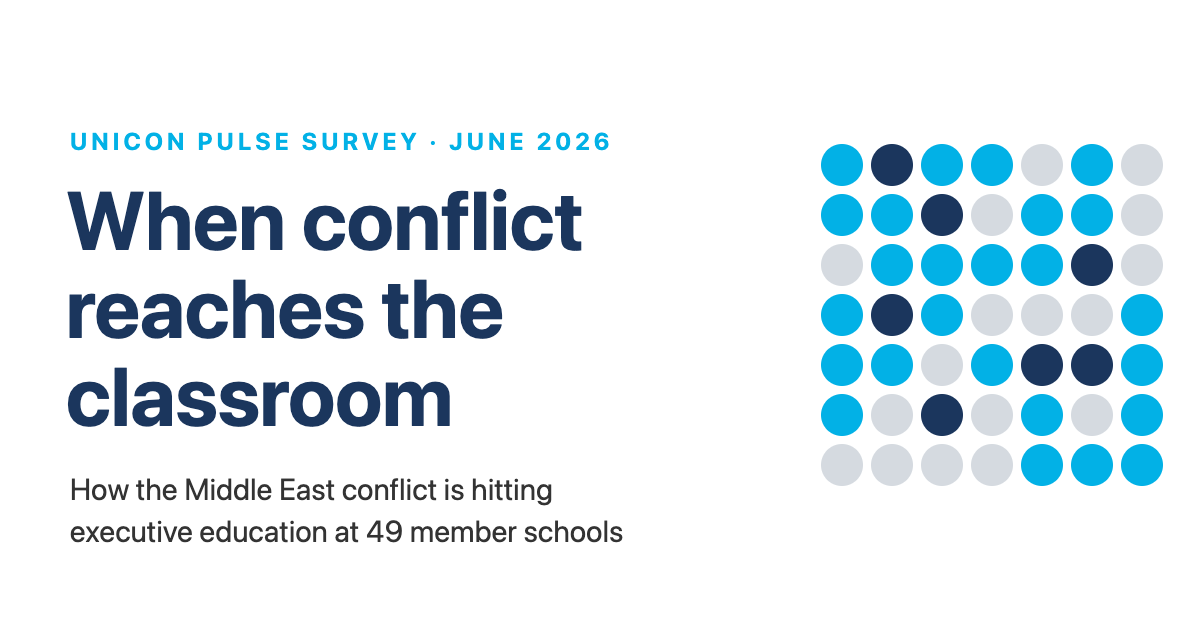
The Middle East conflict has become a sector-wide shock for executive education. Forty-nine UNICON member schools across five regions told us how it is landing, and where it is heading next.
Key findings: the Middle East conflict and executive education
- 65% of the 49 responding UNICON member schools say the Middle East conflict has affected their business operations, and 57% report a revenue impact. However, only 3 schools (6%) report a severe revenue hit.
- Meanwhile, demand is falling faster than revenue: inquiries are down an average of 19% among the 17 schools reporting a change, against an 11 to 12% revenue decline among the 28 schools reporting revenue impact.
- Custom programs are the exposed flank. For example, among schools reporting a decline, custom inquiries fell by a median 40% versus 30% for open enrollment.
- At the same time, faculty travel is the binding constraint: 59% of schools report disruption and 33% have stopped traveling to the region altogether.
- Finally, after any ceasefire, members expect a slow recovery. Rebuilding client confidence was the most cited residual concern (14 of 48 written answers), followed by travel and visa friction (9).
Every chart below is interactive: hover for detail, scroll to watch the numbers build.
Every dot is a member school
Did the conflict affect your business operations?
Click a legend item to isolate that group. Click again to reset.
of schools report operational impact, and more than half already feel it in revenue.
But only 3 schools (6%)
report a severe revenue hit; the shock is wide, but mostly shallow.
The shock in four numbers
A thin, heavily exposed tail is absorbing most of the pain. The next three acts tell the story of how the shock spreads, what the numbers hide, and the road back.
Act I · Transmission
How the shock travels
What members say is disrupting their business
30 written responses · themes may overlap
especially Gulf custom programs
faculty, staff and participants face restrictions or reluctance
proposals go quiet and buying cycles lengthen
oil, austerity and squeezed client budgets
fewer regional participants on open programs
contingency planning, daily policy monitoring and anxious client management tax capacity before they tax revenue.
Operational and revenue impact move closely together
Of 49 schools, severity on operations and revenue moves tier by tier. No school jumps a tier.
Why it matters: cancelled delivery is an early warning signal for revenue risk; watch operations to forecast the P&L.
“Multiple programs postponed/cancelled, and active proposals that have gone quiet.”
— Member school, open-text response
Act II · The numbers underneath
The trough is still ahead
Demand is falling almost twice as fast as revenue
Average % change over the past 3 months, affected schools only
Every school’s number; the spread the averages hide
Each dot = one reported % change. A school can appear once per measure (Open Enrollment and Custom plotted separately). Hover a dot for its value.
Custom programs are the exposed flank
Median decline among schools reporting a decline
Custom work depends on in-region delivery and client mobility, exactly what the conflict has disabled.
20% cannot say whether inquiries have moved at all, a visibility gap that will make the downturn harder to manage.
Act III · The road back
A long runway to recovery
Faculty travel is the binding constraint; 6 in 10 schools disrupted
Faculty/staff stance on travel to the region · 10 icons = all 49 schools · hover an icon
One school selected two travel stances, so shares sum to more than 100%.
European schools report the highest operational impact among responding members
% reporting operational impact, by main office location · small bases, directional
What lingers after a ceasefire; the residual concerns, ranked
Numbers show how many members raised each concern · 48 written answers, themes may overlap
Hover a milestone for detail (swipe sideways on a phone). Marker size follows the number of members raising each concern.
Six schools independently flag a reputational drag on US-based institutions: clients and learners hesitant to engage “as a matter of principle.” For a consortium that is half North American, this is collective exposure worth tracking.
- 1Does revenue decline toward the −19% inquiry signal?
- 2The post-ceasefire backlog: postponed programs returning all at once, straining delivery capacity.
- 3Whether the US reputational drag shows up in enrollment and partnership data, not just sentiment.
Reading notes: inquiry/revenue % changes are averages among affected schools only (bases 17 and 28). Travel shares sum to more than 100% (one school selected two stances).
Frequently asked questions
How has the Middle East conflict affected executive education providers?
In UNICON’s June 2026 Pulse Survey, 65% of 49 responding member schools reported that the conflict had affected their business operations and 57% reported a revenue impact. Specifically, the most cited disruptions were paused or cancelled programs (especially Gulf custom programs), travel disruption for faculty, staff and participants, and a slowing client pipeline with proposals going quiet.
Which executive education programs are most exposed to the Middle East conflict?
Custom programs. Among schools reporting a decline, custom program inquiries fell by a median 40% and revenue by 17.5%, compared with 30% and 15% for open enrollment programs. This is because custom work depends on in-region delivery and client mobility, which the conflict has disabled.
Has the Middle East conflict stopped business school faculty from traveling?
Partly. 41% of schools report no change to travel, 29% travel only with strict precautions, and 33% are no longer traveling to the region. Even so, 5 of the 7 severely impacted schools continue to travel with strict safeguards.
What do executive education providers expect after a Middle East conflict ceasefire?
A long recovery. In particular, of 48 written answers, 14 cited rebuilding client confidence (months to years), 9 cited ongoing travel and visa friction, 8 squeezed learning and development budgets, 7 the risk of re-escalation, and 6 a reputational question for US-based institutions.
What is the UNICON Pulse Survey on the Middle East conflict?
A short survey UNICON, the global consortium of university executive education providers, runs among its member schools to take the industry’s temperature on fast-moving issues. The June 2026 edition on the Middle East conflict drew 49 responses across five regions. Analysis was produced with Dcode Consulting.
About this Pulse Survey
UNICON Pulse Survey on the Middle East conflict and executive education, fielded in June 2026 among UNICON member schools. Overall, 49 schools responded across five regions: US and Canada (25), Europe (11), Asia and Oceania (6), Latin America (4) and the Middle East and Africa (3). Analysis produced with Dcode Consulting. Related: UNICON’s Executive Education in Turbulent Times webinar on October 1 picks up the recovery theme.
Prefer the static version?
Download the full Pulse report (PDF)