What Women Want: UNICON & CarringtonCrisp Webinar Recap

Webinar recap

Held Thu 12 Feb · 11am ET | 5pm CET

Unlocking the power of executive education for women’s career success

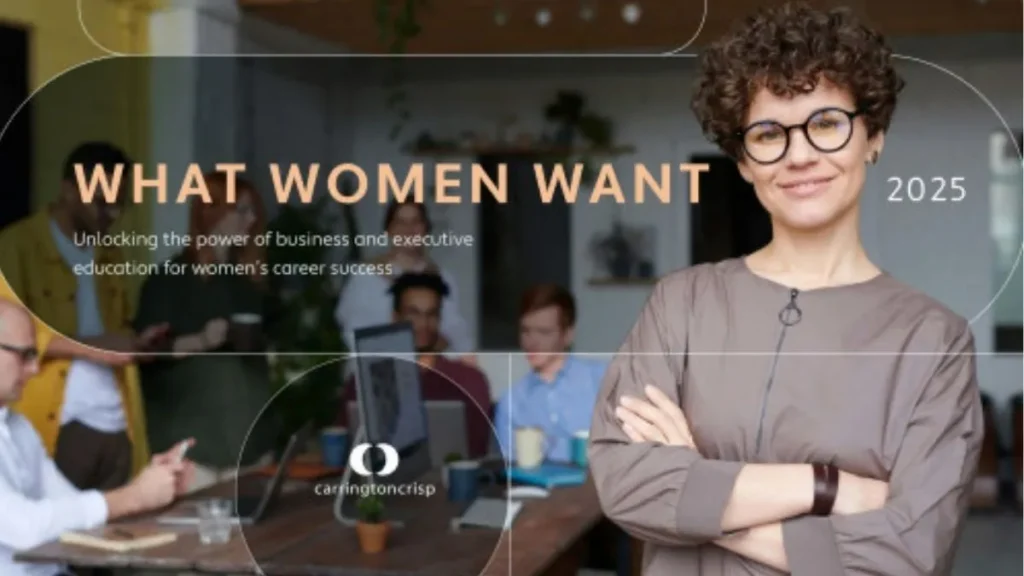
Yesterday, UNICON hosted a webinar with CarringtonCrisp to explore What Women Want—and what executive education leaders and employers can do to better support women’s career progression and leadership readiness.

The session drew on insights from the What Women Want 2025 study, which highlights a persistent reality: despite decades of progress, women remain underrepresented in leadership roles across most sectors and regions. Participants discussed the barriers that continue to slow progression—such as limited access to senior networks, work–life imbalance, and a lack of flexible career pathways—and the practical role executive and business education can play in building confidence, expanding opportunity, and accelerating advancement.

Andrew Crisp, CarringtonCrisp

Speaker: Andrew Crisp

Drawing on considerable experience in research, strategy and communication, Andrew has built CarringtonCrisp into a global brand, known for its work across business schools and universities worldwide.

Host & moderation
Marta Pimentel, Nova SBE

Marta Pimentel (Nova SBE)

Opened the webinar with welcome remarks.

Shalini Bhatia, UNICON Board Chair

Shalini Bhatia (UNICON Board Chair, Stanford University)

Managed the live Q&A.

Research snapshot: Two global surveys conducted in May 2025—5,000+ women (25–55) across 26 countries and 500+ employers across 28 countries—plus 25 in-depth interviews with women at different career stages and 10 employer interviews.

What Women Want 2025: by the numbers

72%
of employers agree that more needs to be done to support career advancement for women in our organisation.
74%
say executive education significantly helps women advance their careers.
79%
of women surveyed confirm that executive education increases women’s readiness for leadership.
75%
of women think that executive education helps women compete equally alongside men.
81%
of women believe business and executive education can address workplace challenges.
77%
of employers agree that more interventions earlier in women’s careers would create a larger talent pool later for senior positions.

Key takeaways from What Women Want 2025

  • Executive education is seen as a powerful lever: The research points to strong belief—among women and employers—that executive education can support women’s career growth and leadership readiness.
  • Mind the “disconnect”: A recurring theme is the gap between employer intentions and lived experience—where organisations may feel they are doing enough, while women still report barriers to progression.
  • Format matters as much as content: Flexible delivery (including blended options) can be a decisive factor in making learning accessible—especially when time, workload, and caregiving responsibilities collide.
  • Networks and follow-through are critical: The value of executive education increases when learning is paired with mentoring, sponsorship, and opportunities that extend beyond a traditional alumni network.

The webinar discussion also reinforced a practical design insight for providers: in a world where content is increasingly abundant, participants are often “buying” the experience—including relevance, flexibility, peer learning, and the support that continues after the programme ends.

Up Next:

Executive Education in the Age of Lifelong Learning — Eight strategic choices for executive education leaders (UNICON Research Webinar)
UNICON Research Webinar Thu 5 March · 11am ET | 5pm CET